
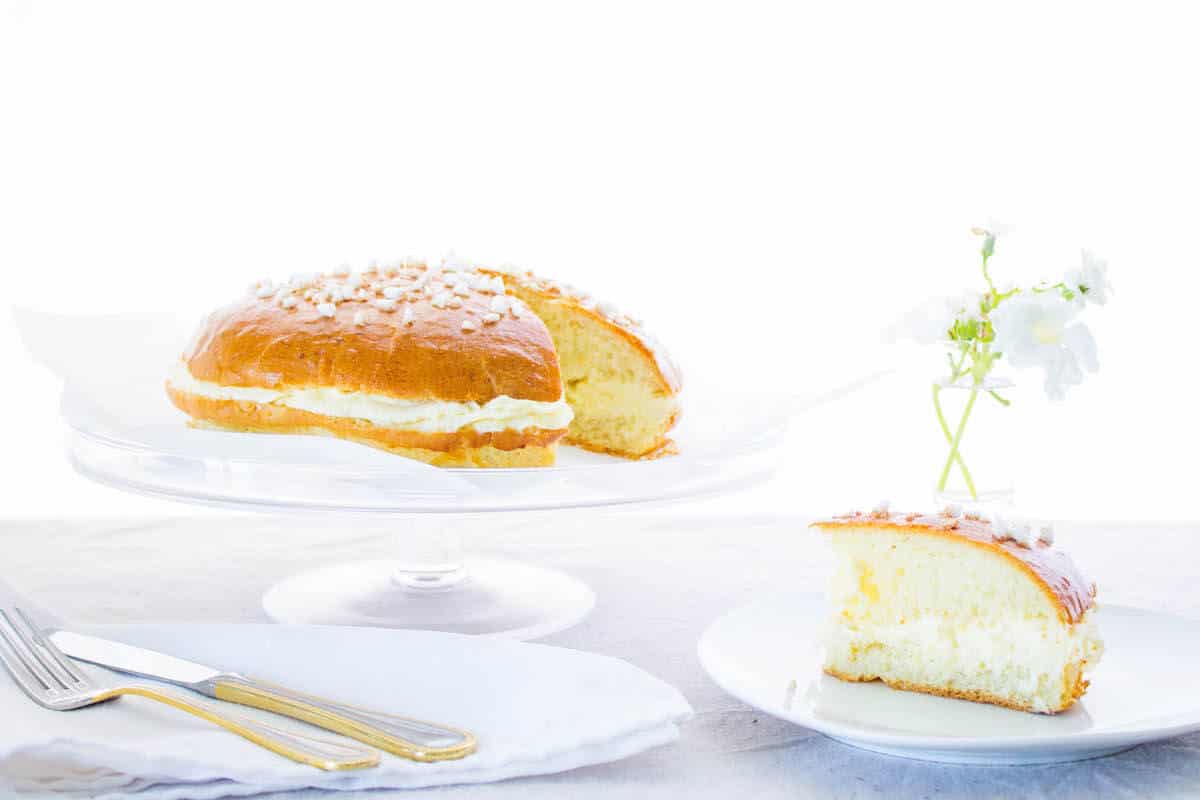
Tarte Tropézienne Recipe
Made famous as Brigitte Bardot’s favorite French pastry, a tarte tropézienne recipe combines the best of French patisserie. Made with a brioche dough and a creamy custard filling, after one bite of this heavenly dessert, you’ll know exactly why it was a favorite of the French actress!
What is Tarte Tropézienne made of?
This tart is not your typical tart. A tarte tropézienne is more akin to a cake that’s been filled with custard. The cake-y part of the tart is made with a brioche dough, so it’s not necessarily sweet.
The custard filling is where you’ll find the sweetness in this pastry, which is what makes this a dessert rather than a breakfast bread. The custard also has whipped cream folded into it, which actually makes the filling a combo of custard and cream. In French, this combination is called Crème Diplomate.
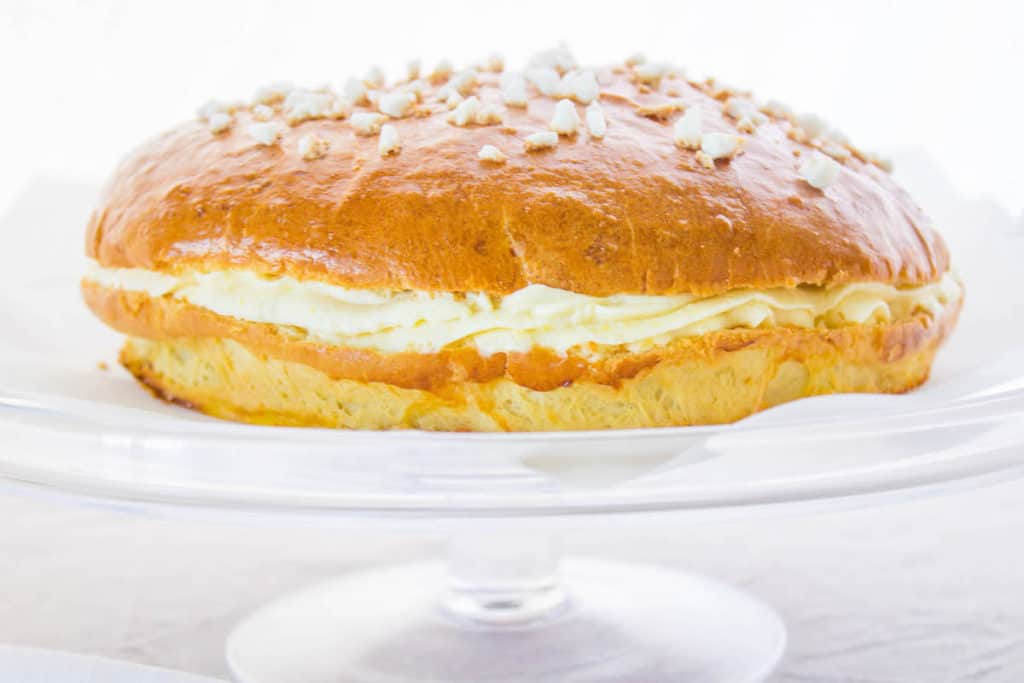
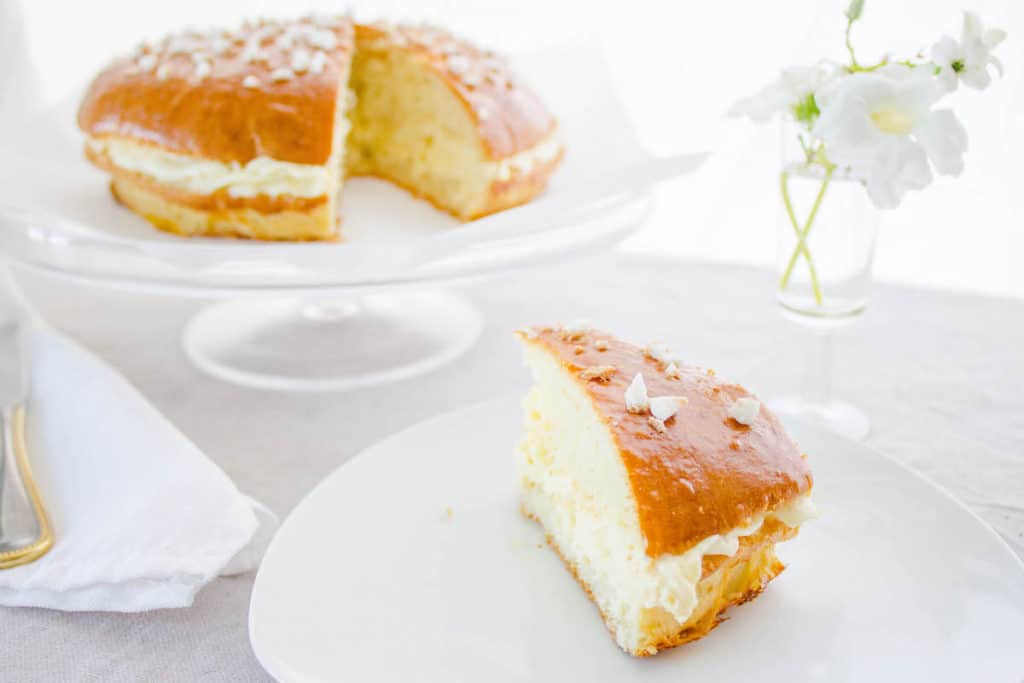
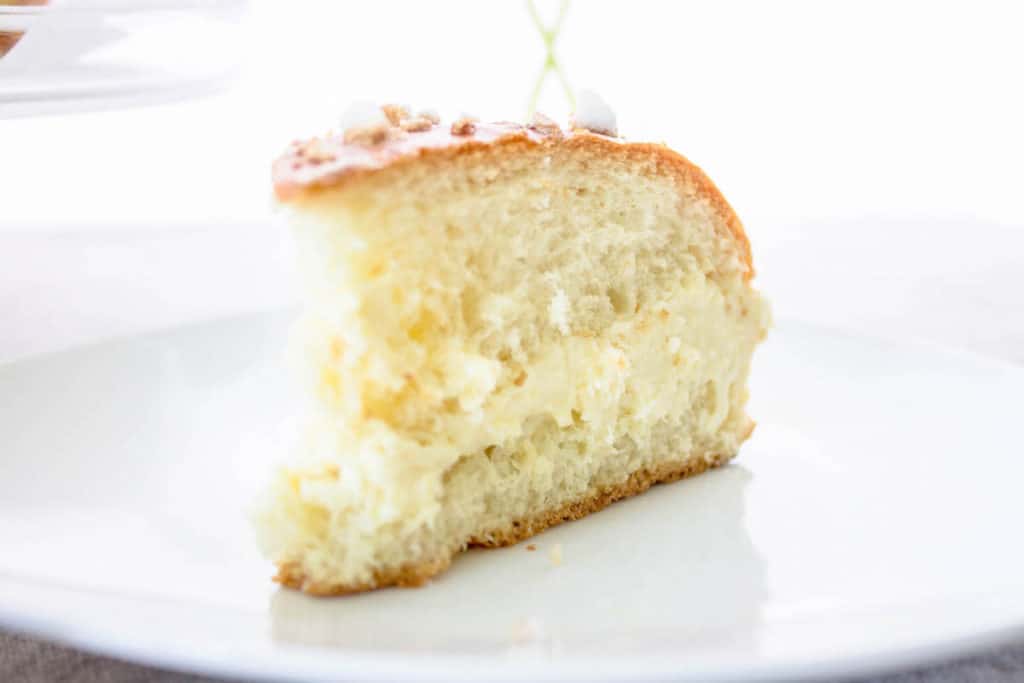
The brioche layer is incredibly light and fluffy, so much so that I initially cut myself a small sliver, thinking it would be decadent enough to suffice, and ended up going back for seconds because the slice was quite literally gone in seconds. I couldn’t believe how light and airy the tart was the first time I tried it.
Where is Tarte Tropézienne from?
This French pastry is from St. Tropez, a coastal town in the French Riviera. This pastry may have never become famous if it weren’t for Brigitte Bardot.
Back in the 1950’s, Bardot was filming a movie in St. Tropez called “And God Created Woman.” The caterer for the movie set, Alexandre Micka, had created a special French pastry using a mix of French techniques and a recipe given by his grandmother.
Bardot loved the pastry so much, she insisted it be given a name and recognized, and so it was named after the town in which it was created.
The Tarte Tropézienne was born and grew in popularity, and the world of pastry became a little bit more special.
What is Tropézienne cake?
While in the States we often think of a tart as something that resembles pie just made in a special tart pan with a shortbread crust, the tarte tropézienne is actually more of a cake.
As mentioned earlier, the crumb for this cake is made of brioche, which has a sweet, vanilla custard filling nestled between its two layers. The custard is a wonderful contrast to the cake layer, both in texture and flavor.
Tips on How to Make La Tarte Tropézienne
If you’ve never made brioche dough, you may want to check out my brioche recipe post and try making a brioche loaf or rolls first.
Otherwise, here are some tips you’ll want to take note of as you create this recipe:
- A food thermometer is your friend. When you’re making yeast-doughs like brioche, it’s important that you measure the temperature of your liquid to get it just right. Too hot and you’ll kill the yeast, too cold and you’ll never activate it properly.
- There’s a lot of resting and chilling involved in making brioche, and that’s to ensure the yeast properly develops in the dough without proofing too much. Be sure not to skip these important periods.
- When making the custard filling, be patient. Do not leave your custard unattended over the stove. The custard will go from runny liquid to pudding-like in a matter of moments, and if you miss the opportunity to remove the custard from the heat, you’ll end up with a clumpy mess.
- If you can’t find pearl sugar, you can simply chop up sugar cubes into really small pieces. It’s not as perfect looking as the pearl sugar, but it will create the same effect!
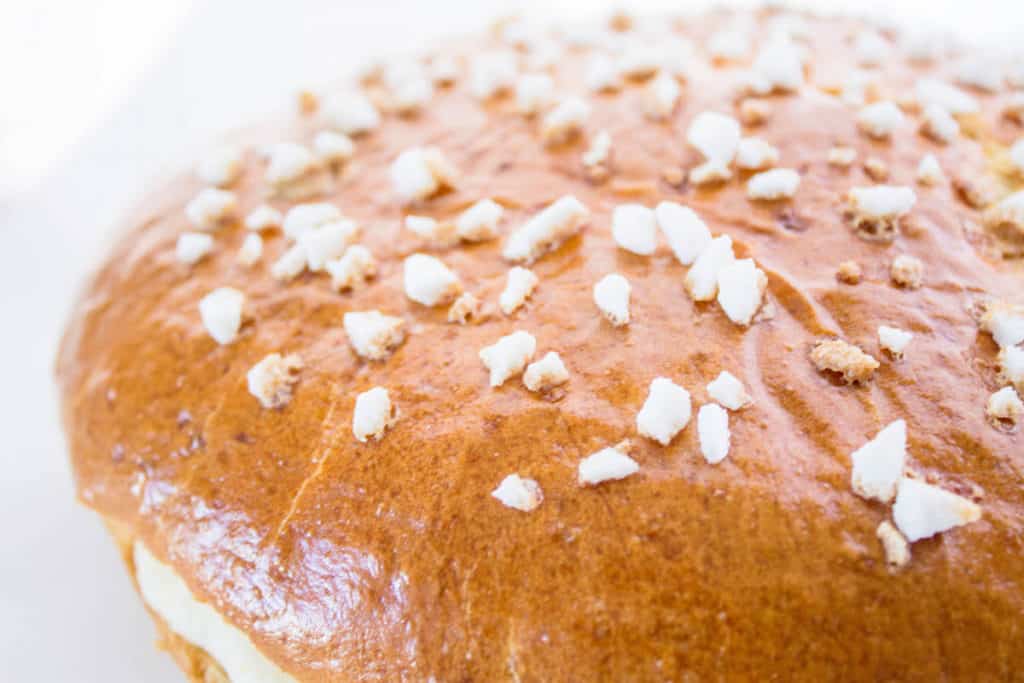
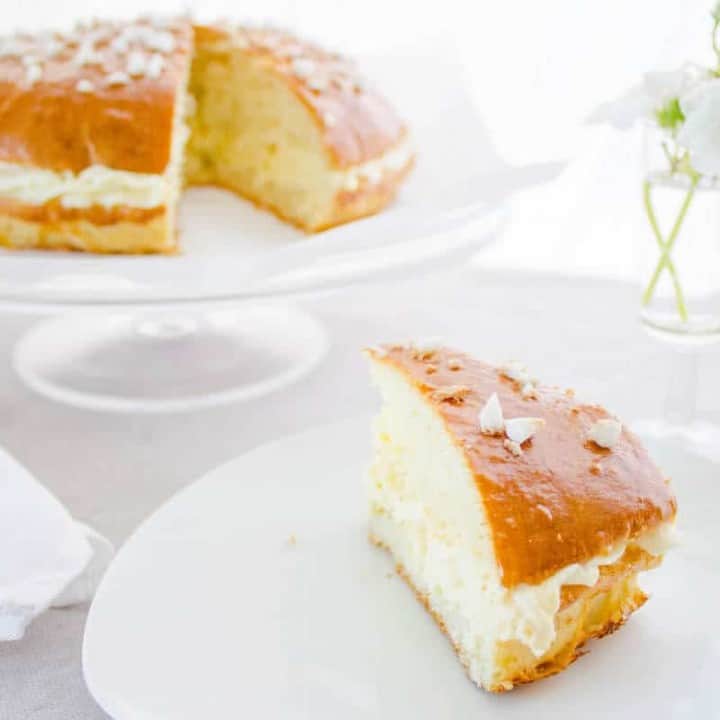
Admittedly, a tarte tropézienne is not the quickest pastry to make, but if you’ve made brioche, then you can understand that. I would imagine this tarte tropézienne to be a wonderful dish for a special brunch or afternoon high-tea as it’s a beautiful sight to see and an absolutely lovely treat to eat!
Tarte Tropézienne Recipe
A light and creamy custard filling is sandwiched inside two layers of fluffy brioche to create this famous French cake!
Ingredients
for the cake
- 2 1/4 tsp dry active yeast (1 packet)
- 1/4 cup whole milk, warmed to 110°F-115°F
- 2 cups all-purpose flour, plus more as needed and for dusting
- 2 1/2 tbsp granulated sugar
- 2 eggs, room temperature
- 1/2 tsp table salt
- 1 tsp vanilla extract
- 1/2 cup unsalted butter, room temperature and cut into tablespoon-size slices
for the custard
- 2 cups whole milk
- 3 eggs
- 1 egg yolk
- 2/3 cup granulated sugar
- 1/4 cup cornstarch
- 1/4 cup flour
- 1/8 tsp salt
- 1 tsp vanilla extract
- 1/4 cup heavy cream
for the topping
- 1 egg, for egg wash
- pearl sugar or crushed sugar cubes for topping
Instructions
To create the cake
- In a small bowl, add the dry yeast, then follow with the warmed milk. Make sure the milk is exactly the right temperature as this is what will activate the yeast. Do not stir; let the mixture rest for 5 minutes. It should look bubbly/frothy.
- Meanwhile, mix the flour and sugar in the bowl of a stand mixer on low speed with a paddle attachment. Pour the yeast mixture into the bowl of flour and sugar using a spatula. Turn the mixer on to low speed and mix just until the yeast is mixed in.
- Add in the eggs, salt, and vanilla. Continue mixing on medium speed for 5 to 8 minutes, stopping every once in awhile to scrape the batter off the sides of the bowl. Drop in the butter slices, one piece at a time, and raise the speed of the mixer to medium-high speed. Continue mixing until the dough comes together, and pulls away from the sides of the bowl.
- Use your spatula to incorporated any unmixed butter into the dough better. Turn the dough out onto a well-floured surface. Roll the dough into the flour and flatten it out into a disc shape. Place the dough in a large bowl and cover the bowl with a sheet of plastic wrap. Then turn on your oven's warm/hold setting on for 30 seconds. Turn off the oven and then place the bowl in the oven for its first rising phase; about 1 hour or until doubled in size.
To create the custard
- Warm the milk in a medium saucepan over medium heat until the milk begins to simmer.
- In a medium bowl, combine the eggs, sugar, cornstarch, flour and salt. Slowly stream in 1/4 cup of the hot milk into the egg mixture, whisking vigorously as you do. Pour the egg mixture into the saucepan with the hot milk, then whisk this mixture continuously over medium-low heat until it thickens into a pudding-like consistency.
- Pour the custard into a bowl, then add the vanilla extract; stir to combine. Cover the custard with a sheet of plastic wrap, placing the plastic directly onto the custard. Refrigerate the custard until chilled and ready to use.
Back to the dough
- After the dough has finished rising, take off the plastic wrap, and lift up the dough from each of its sides to slightly stretch it out. Again, place back in the bowl and cover with plastic wrap. This time, place the dough in the freezer to stop the dough's development; freeze for 30 minutes. Then, transfer the dough to the fridge to chill for an hour.
- Place your dough onto a floured surface and roll out the dough until it's 5 to 6 inches wide in diameter. Place this dough circle on a baking sheet fitted with a piece of parchment paper. Cover loosely with a sheet of plastic wrap. Turn on the oven's warm/hold setting for 30 seconds before turning the oven off and placing the baking sheet in the oven for the dough to rise; about 1 hour.
- Take the dough out of the oven and preheat the oven to 400°F. Create an egg wash by adding a splash of water to a small bowl containing 1 egg. Beat the water and egg together before brushing this egg wash onto the dough. Add the crushed sugar to the top.
- Place the dough in the oven and immediately reduce the oven temperature to 350°F. Bake for 20 to 25 minutes, or until the top and edges of the cake are a deep golden brown. Transfer the cake to a wire cooling rack and let cool to room temperature.
To assemble
- Once the cake is cool, finish your custard. Whip the heavy cream on high speed until stiff peaks form. Use a rubber spatula to fold the whipped cream into the custard until the custard is loosened up a bit. The custard should be creamy, but should not fall off your spatula easily.
- Use a sharp, serrated knife to horizontally cut into the cake and split it into two layers. Cut the cake so that the bottom layer is thicker than the top layer.
- Use a spatula or a pastry bag to apply the custard onto the bottom layer of cake. Gently press the top layer onto the filling. Refrigerate until cool and ready to serve.
A giant baked donut FILLED with custard? That sounds like the best dessert EVER! I have never heard of such a dessert but I can clearly see I’ve been missing out. It looks absolutely stunning!
Thank you so much, sweets! It doesn’t get much better than a custard filling! 🙂
Oh. My. Gosh. This is soooo stunning, I think I first saw the photographs on your Facebook page, and I was seriously so wowed!!! It looks absolutely incredible, I love everything about this dessert! I’d never actually heard of one before this, but I seriously don’t know where it’s been all of my life?! It’s like heaven in dessert form. Ahh that custard in the middle – *swoon*. I love it!
Thank you so much, Harriet!! The custard layer is sinfully good!! 😉
Stunning!
Thank you, Lynn! XO
This looks beautiful! I’ve never had a tarte tropezienne before but I do love desserts with custard! It sounds so delicious and the pearl sugar topping is such a wonderful addtion.
Thank you, Kelly! At first I thought of the pearl sugar as just a decorative element, but it really did contribute to the taste and overall tastiness of the tart, so I’m glad I decided to follow the recipe and do it! 🙂
Oh my! Yes, this would be so perfect for a high tea! It looks so light that I feel like once I started eating it, it’d just be gone all of a sudden, and everyone would be angry at me because they missed out.
Thanks, Hannah! I couldn’t believe how easy it was to eat. Between my family and I, it was finished by the end of the hour! 🙂
Delicious Tropezienne, Betta! Well done! The crumb on your cake is simply divine. I can just imagine the texture of the cake against the creamy custard filling. A delight indeed! I got distracted, though, by your fabulous video of Pot de Creme’! Congratulations! It’s lovely! It is one of my all time, favorite desserts and it whips up with ease! I’ve not tried your method however, but can see how it would make the creme light as air! Thank for this Beeta. Beautiful post!
Thanks so much, Traci!! As for the pot de creme, I learned how to make it from a small French recipe book I bought in a boutique in the Versailles gardens, and it’s always helped me produce a lovely result, so I hope you get a chance to try! XO
What an adorable tart! It looks like a giant, fairy sandwich. The pearl sugar adds a nice, romantic touch.
I love how your posts combine a bit of history with the food. You capture the beauty and aroma of France so perfectly. It would make an excellent cookbook. 🙂
Aww, thank you so much, Amanda! That is so kind of you to say <3 And I laughed when I read "fairy sandwich." That is perfect and exactly what I always hope all my photos have a touch of…magical pixie dust! 🙂
I have never heard of tarte tropezienne (either) until now… and THANK YOU for the lovely introduction! This tarte not only stunningly bea-utiful, it sounds like it tastes beyond delicious! Your description has me drooling all over the place! I will absolutely HAVE to try this… with the pearl sugar, because you sold me on that as well! 🙂 As always, thanks for making me extremely hungry, despite the fact I just ate lunch! Cheers and warm wishes for a wonderful weekend, Beeta! XO
Thank you so much, Cheyanne! I had been really apprehensive about the pearl sugar, but it was delicious and definitely a great touch to the tart! Hope you’re having a lovely Saturday! XO